How did Sanja Iveković’s work in the 1970s address the rise of consumerist tendencies in socialist Yugoslavia?
This was one of the worst essay's that I wrote at university and ended up getting a 2:2 in. I didn't understand the topic that I was writing on and I picked a module that was far too advanced for me. The referencing in here is not consistent and many of the ideas have not been fully formed or throught through.
How did Sanja Iveković’s work in the 1970s address the rise
of consumerist tendencies in socialist Yugoslavia?
Yugoslavia’s non-alignment policy in 1948 created a uniquely
socialist state with its own specific economic, social and political policies
that differentiated it from its other socialist counterparts. It was a
one-party state under the control of the league of communists led by Tito. It
combined free market socialism and self-management to create a consumer society
whereby the means of production, distribution, and exchange were owned and dictated
by the workers.[1] Other
differences to traditional socialism within the economy included greater
participation in International Trade which allowed for division of labour and
integration with the world economy, exposing the work force to other economic
ideas outside the sphere of socialism. There were also greater civil liberties
to a certain extent for its citizens which included the rise in consumerist
tendencies and the perception of art within society. In 1971 to 1975, the
annual average growth rate of private consumption such as food and cloths but
excluding household items was 5.3 percent.[2]
This includes all purchases made by consumers such as food and cloths but does
not extend to household items.[3]
The artist Sanja Ivekovic explores how successfully the rise of consumerist
tendencies affected the state in three case studies: Sweet Violence (1975-76), Double Life (1959- 1975) in the Unknown Heroine exhibition
and Triangle (1979).
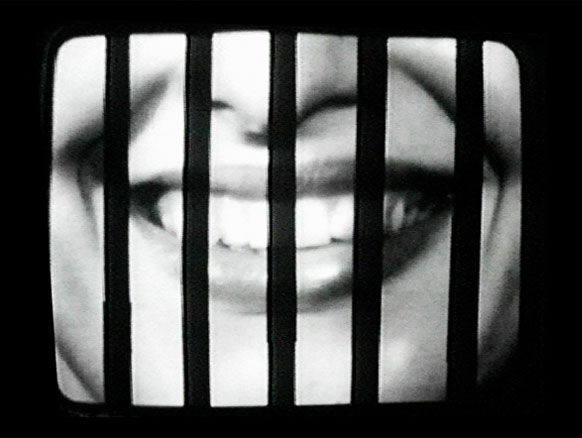
Video moment taken from Sweet Violence.

Image taken from a page in the Double Life work.

The four photographs that make up the exhibition of Triangle. One of her most notable works.
Ivekovic’s conceptual artistic style was used to avoid the general
commercialization and the destructively ‘progressive’ approach of modernism and
consumerism.[4]
Lippard called it the ‘dematerialisation’[5]
of art which was no longer merely seen as a decorative object that was to be
hung in a gallery wall but rather it had been transformed into art for the
people. The increase in consumerism meant that people no longer valued the
goods that they had because it was easier to be able to afford and buy them. Welch said that the state
opened up “new channels for the production and distribution of critical
practice”[6]
of art. Yugoslavia was not harsh in its
censorship towards art and there was more tolerance than brutality present in
their censorship.[7] In
Triangle, even though there was the presence of police officers and secret
police (UDBA) during the parade for Tito they were less aggressive than their
counterparts in other satellite states. Ivekovic was asked to leave the balcony
but she was not arrested and there was no violence involved. Conceptualism also
used different artistic and media techniques to communicate with the people and
other negate the image that art was merely for decoration. Sweet Violence was a
video art performance and one of the first explorations into using film. She
was able to penetrate the private sphere and communicate and interact more
directly with her audience. Conceptualism allowed artists different methods for
artists to express themselves in the face of growing commercialization.
The increase in consumerism was also not just limited to material goods
but also to experiences which further helped to shape the new art movement and
depict the daily lives that people had to endure under the new socialist state.
Ivekovic herself said, “the conceptual
artists of the first generation were not only asking what art is, but who are
the artists, what’s your identity?”[8] People were allowed
to travel abroad and go to social events such as the cinema and music events
which exposed them to experiences outside their own country. Her art attempted
to overcome its commodity status and subservience to the art market through the
liberation and expression of individual people’s opinions which grew into political
relevance through the artistic process.
The increased rate of consumerism in the 1970’s counteracted the
socialist promise of an equal political culture because commodity production
inevitably generated social inequality due to increased market mechanism. [9]
Money was exchanged with an open and understood system of value and time
trade-offs in a market that wanted to optimize distribution of goods and
services. Not everyone was able to afford the same amount of consumer goods as
each other. Archer, Duda and Stubbs suggest that there was the presence of both
the working class and an upper or bourgeoise class known as the New Class who
were more likely to be able to afford consumer goods.[10]
Mates describes the situation in Yugoslavia in the following manner:
“It seems incompatible with a socialist society’s principles... a large
number of citizens do not have their basic life needs satisfied… while other
citizens at the same time have the possibility to spend millions at New Years
Eve parties in Kathmandu.”[11]
The Yugoslav league of communists was supposed to represent the
aspirations of the working class who were supposed to hold the leading
political position as the basic force of the socialist state. The continued
presence of the bourgeoise due to the rise of consumerist tendencies
demonstrated that they had failed to create a ‘classless’ society which
involved the withering away of the state, a key aspect of socialism.
Ivekovic use of public spaces to showcase her art brought awareness to
the divide between the consumer fantasy and the reality of people’s lives
caused by the increase of consumerism. The student riots of 1968 formed the
Belgrade Student Union (SKC) which was seen as the main cultural focal centre
where artists and professors were able to meet and discuss their ideas. The
government also tolerated the opening of other public spaces for contemporary
art such as art galleries. There was the Youth Tribune in Novi Sad and the
Gallery Nova in Zagreb. In Double Life, Ivekovic places photos of herself from
her own personal album were placed alongside similar photos in terms of
location and position from adverts in magazines. For an example, a photo of a young
Ivekovic is contrasted against another photo of a model from an Estee Lauder
hair campaign.[12]
Women were historically seen as invisible but they had internalised the
language of advertising even while they are not aware of it. Many of the photos
used predated the ones in the magazines, they had not been staged deliberately.
These photos
promote the abundance of luxury goods that were present everywhere,
displayed at home or being sold in supermarkets and department stores. Many of
the advertisements were placed in women’s magazines and there are 64 photos in
the collection, further suggesting that there were many advertising photos for
Ivekovic to choose from because there was a rise of consumerism.
There are other
examples within Ivekovic’s work that further critiqued the division between the
consumer fantasy and the socialist reality. Triangle was a short 18-minute-long
performance piece whereby Ivekovic was sitting on her balcony while a motor car
parade for the president Tito passed by. There were many people in the parade who
were celebrating but the presence of the secret police and policemen in the
streets indicated that there were still issues with the socialist state as they
had not achieved total support of the people. Ivekovic was asked to go back
inside her apartment because they did not want to see that not everyone
supported Titoism. 18 minutes was not a very long time, they had been
constantly watching the population closely. She was told ‘the persons and objects are to be
removed from the balcony’[13]. The ‘objects’ was a
reference to the bottle of whisky that she was drinking and the novel she was
reading. They were able to see in great detail what she was doing from the
rooftops through the use of binoculars. There was still a tight monopoly of
power from the league of communists as they wanted to maintain ‘visual order’
and create the illusion that they were a prosperous and popular socialist
state. In this instance, Ivekovic has used conceptual art to expose the reality
of life in the socialist state that was not as commercially or politically
success as the government had hoped.
The rise in consumerist tendencies had created a dream that almost
seemed unattainable to ordinary members of the socialist society. In Sweet
Violence Ivekovic uses the black masking tape over the screen to disconnect
viewers from the ‘sweet violence’ of media culture, a term originally used by
the Italian journalist Guido Guarda.[14]
The TV advertisement from the washing machine company, Obod, was not only
offering the machine but also the fantasy and luxury of owning one. In the
advert, the appliance is utterly removed from its natural setting in the home
which is the actual site of housework. It is floating over the surface of a
beautiful and calm blue sea, creating the idea of a holiday and paradise.[15]
Women were usually in charge of household chores, the advertisement was
offering them the luxury of being free from them because it would reduce the
time needed to wash the cloths. The washing machine was trying to liberalise
the modern women. It was not a common object in everyone’s household, “the
woman who wants a washing machine dreams about”[16]
because not everyone was able to afford one despite the perceived abundance and
access to these goods. In Double Life, there was a disconnect between the
models in the advertisements and the personal photos. The models were
representing the fantasy of the Yugoslav dream where there was an abundance of
items that people were able to buy. Their aims were similar to the American
capitalist Golden Dream. It could also be interpreted as the divide between the
workers who were still not able to afford those items and the continued
presence of the bourgeoise to whom the advertisements were aimed at. The rise
of consumerist tendencies had not affected everyone equally as there was still
disparity between attainable objects and the ‘dream’ of attaining them.
Workers had even less control over the economy due to the deviation from Yugoslavia’s
self-management structure which gave rise to a socialist market economy, creating
a hybrid culture of socialism and capitalism. Self-management was not an
efficient method to deal with the increased consumer demands because the
workers favored giving themselves short term bonuses rather than investing in
productive equipment that would be beneficial in the long term. The failure
of the self-management model triggered the need for economic reform which
further took power away from the workers. The 1976 Associated Labour law (BOAL)
gave workers a position in the organization based on the precise role that they
played within the role of production.[17]
The election of a worker’s council and managers was a socially democratic act
because the managerial board was given power over the workers. They determined
the wages that they were paid and were involved with the day to day basis of
running the business. Ivekovic
wanted to use her art to return to the true roots of socialism. She was a
student during the 1968 student riots and their political ideology also had an
effect on her art work. She wanted to re-instate central state planning due to
increased de-centralized state planning. The decisions regarding the allocation
of resources and number of outputs was determined by independent economic
organizations that did not follow one general economic plan, resulting in price
distortions and regional disparities. In Sweet Violence, footage was
altered from the Yugoslav televisions daily economic propaganda programme,
(EPP) which was a mixture of socialism and free market capitalism.[18]
In one particular black masking tape was placed over words on a Coca Cola
bottle to spell out the word ‘liar’. It was a ‘lie’ that Yugoslavia was truly a
socialist state, even the drink Coca Cola was seen to come from capitalist
countries.
The failure of self-management further caused further class
disparity, exasperated by the rise in consumerist tendencies. It caused social
unrest, these were the reasons for the policemen during the parade in Triangle.
Not all the different social classes supported the league of communists. There
was a high level of inflation, from 1971 to 1991, Yugoslavia’s annual inflation
rate was 76%.[19]
Some members of the working class were not able to buy food and gas for
transport. At the beginning of the 70’s there had been improvements in the rate
of employment but the introduction of self-management and a market economy
meant that there was still high levels of unemployment towards the end of the decade.
There was also regional disparities and widespread emigration as people left
the country to find better work and pay in other socialist countries, most
notably the GDR.[20] The
managerial boards created due to the self-management policy further diminished
the rights and culture of the workers. In some instances, workers still
struggled against their managers in order to gain more power. Trade Unions were
supposed to support the workers and given power over the workers council but
they were essentially used as a government tool that did not have real power.
There was the slow privatization of social property and industry as factories
and warehouses closed down. Soviet Union propaganda cast Tito as the ‘butcher’
of the working class through the introduction of corporatism, which meant that
the workers were slowly losing their rights within their own industrial
organizations. This was caused by the need to keep up with the demands
triggered by the increase in consumerism.
Feminism
was also a capitalist movement that was not seen as necessary in a socialist
state whereby men and women had been legally emancipated equally through the
introduction of progressive state policies. The patriarchal structure of
society meant that communism had failed to acknowledge that women were still
divided by unwritten rules. Women were allowed to work and have equal rights to
their husbands in marriage but they were still expected to look after the
household and raise the children. Ironically the title of Double Life can be
seen to refer to the double standards that women had to endure. Women’s
organisations were banished because they were no longer deemed as necessary by
the government as they had achieved everything that they could have wanted
under socialism. The feminist meeting “Comradess woman. The woman’s question: A new approach?” in 1978 was one
of the first and most important feminist events in a socialist state because it
acknowledged that Yugoslavia had not been able to create a completely equal
society for both men and women. It was also significant that the meeting was
held in the Belgrade Student Union, a place where art was also shown because
the two ideas were linked together. Ivekovic was marking “different ways
in which the political is established”.[21]
In Triangle, there are two different narrations present. The wide shots of Tito
in the parade and the secret police contrasted with the much more intimate and
close-up shots of the artists herself. Tito and the secret police represented
the heavy and oppressive male gaze of the state but there was also the presence
of the feminist self. Ivekovic was a feminist artist that was trying to create
a separate female narrative in order to give women a voice that had been
constantly silenced.
Ivekovic used her artwork to criticise the contradictive
nature of the Yugoslavian government because true socialist states could not
create consumer societies without compromising their ideology. Yugoslavia
claimed to give power back to the workers through the system of self-management
and de-centralized planning. Managers and private companies were still in
charge though the implementation of capitalist elements and the continued
presence of a work place and social hierarchy. The Communist party was simply
re-named to become the League of Communists. They failed to achieve social
equality. For many, having an excess of luxury items was still a consumer
dream. Market socialism had always remained imperfect, culminating in the
economic recession at the end of the 1970’s. Despite the rise on consumerist
tendencies, it was not enough to save the economy as there were fundamental
problems with a socialist economy.
Bibliography:
Journals:
Arthur House, “State
of the art: rethinking Yugoslavia, the dictatorship that embraced
conceptualism” The Calvert Journal
(2016),
http://www.calvertjournal.com/articles/show/5354/yugoslavia-art-nottingham-contemporary-monuments-should-not-be-trusted-lina
Ernest Mandel, “Yugoslav economic theory” Monthly Review, Vol 18 (1967)
Klara Kemp Welch,
“Taking Women’s rights seriously?”, Third Text, Vol 23 (2009)
Ramnath
Narayanswamy, “Yugoslavia: Self-Management or Mismanagement?”, Economic and Political Weekly, Vol. 23
(1988)
Websites:
“Consumption” Focus
economics, https://www.focus-economics.com/economic-indicator/consumption
accessed: 28/12/2018
Steve. H. Hanke, “The World’s Greatest Unreported
Hyperinflation”, CATO Institute, accessed: 05/01/2019 https://www.cato.org/publications/commentary/worlds-greatest-unreported-hyperinflation
Books:
Lucy Lippard, “Six Years: The Dematerialization of the Art
Object from 1966 to 1972” in Conceptual
art: An Anthology, ed, Alexander Alberro, Blake Stimson, Revised, (London:
MIT Press, 1999)
Patrick Patterson, Bought
and Sold: Living and Losing the Good Life in Socialist Yugoslavia (Cornell:
Cornell University Press, 2011)
Rory Archer, Igor Duda and Paul Stubbs. Social inequalities and discontent in
Yugoslav socialism. (London: Routledge, 2016)
Ruth Noack,
Sanja Iveković: Triangle, (London:
Afterall Publishing, 2013)
Newspaper:
Carol Kino,
“Croatia’s Monumental Provocateur”, The New York Times, Dec 22, 2011, accessed
15/12/2018,
https://www.nytimes.com/2011/12/25/arts/design/sanja-ivekovic-croatias-monumental-provocateur.html
Catalogue:
Sanja Ivekovic Unknown Heroine, ed by Lina Dzuverovic, London:
South London Art Gallery in association with Calvert 22, 2012-2013. Exhibition
Catalogue, accessed 20/11/2018
https://www.southlondongallery.org/wp-content/uploads/2018/01/2012SI_gallery-guide.pdf
[1] Ernest
Mandel, “Yugoslav economic theory” Monthly
Review, Vol 18 (1967), pp. 40-49
[2] Patrick
Patterson, Bought and Sold: Living and
Losing the Good Life in Socialist Yugoslavia (Cornell: Cornell University
Press, 2011), pp. 39
[3] “Consumption”
Focus economics, https://www.focus-economics.com/economic-indicator/consumption
accessed: 28/12/2018
[4]
Lucy Lippard, “Six Years: The Dematerialization of the Art Object from 1966 to
1972” in Conceptual art: An Anthology, ed,
Alexander Alberro, Blake Stimson, Revised, (London: MIT Press, 1999), pp. 294
[5]
Ibid, pp. 294
[6]
Klara Kemp Welch, “Taking Women’s rights seriously?”, Third Text, Vol 23 (2009), pp. 819
[7] Arthur
House, “State of the art: rethinking Yugoslavia, the dictatorship that embraced
conceptualism” The Calvert Journal(2016), http://www.calvertjournal.com/articles/show/5354/yugoslavia-art-nottingham-contemporary-monuments-should-not-be-trusted-lina
[8] Carol
Kino, “Croatia’s Monumental Provocateur”, The
New York Times, Dec 22, 2011, accessed 15/12/2018, https://www.nytimes.com/2011/12/25/arts/design/sanja-ivekovic-croatias-monumental-provocateur.html
[9] Mandel,
“Yugoslav economic theory”, pp.
[10] Rory
Archer, Igor Duda and Paul Stubbs. Social
inequalities and discontent in Yugoslav socialism. (London: Routledge, 2016)
pp.7
[11] Ibid,
pp. 189
[12] Sanja Ivekovic Unknown Heroine, ed by
Lina Dzuverovic, London: South London Art Gallery in association with Calvert
22, 2012-2013. Exhibition Catalogue, accessed 20/11/2018 https://www.southlondongallery.org/wp-content/uploads/2018/01/2012SI_gallery-guide.pdf
[13]
Ruth Noack, Sanja Iveković: Triangle,
(London: Afterall Publishing, 2013), pp. 2
[14] Dzuverovic,
Unknown Heroine
[15]Patterson,
Bought and Sold, pp. 90
[16] Ibid,
pp. 90
[17] Ramnath
Narayanswamy, “Yugoslavia: Self-Management or Mismanagement?”, Economic and Political Weekly, vol. 23 (1988)
pp. 2053
[18] Dzuverovic, Unknown Heroine
[19] Steve.
H. Hanke, “The World’s Greatest Unreported Hyperinflation”, CATO Institute, accessed:
05/01/2019 https://www.cato.org/publications/commentary/worlds-greatest-unreported-hyperinflation
[20]
Narayanswamy, Yugoslavia, Pp. 2053
Comments
Post a Comment